
Streets of Aspiration
ADFF : STIR | Mumbai 2026
Client STIR World
Area 40 Sq.m
Status Completed 2026
Team SJK Architects
Team Lead Pragati Dighe
Visualizer Tharun CM
Communications Anusha Jasubhai

With Build Kraft India
The Streets of Aspiration
The Ivory Tower
The Underbelly
Our pavilion represents the multiple Mumbais connected through the dynamic, pulsating streets of Mumbai, constantly under construction and reinvention
Mumbai is a city built on contradictions—where aspiration and exhaustion, privilege and precarity, constant motion and brief pauses exist side by side. When we were invited to interpret this city through a pavilion, the entire office chose to participate. We divided ourselves into eight groups, each identifying a specific tension or disjunction embedded in daily life. These explorations were later synthesised through a core working group, shaping a single pavilion that could hold multiple truths about Mumbai and allow each to find space.
The Core Disjunctions :
Several disjunctions surfaced repeatedly. The most fundamental being the stark inequality that endures in Mumbai—the coexistence of wealth and scarcity, formal and informal living conditions, occupying the same geography but rarely sharing the same experience. Yet this inequality churns itself into a peculiar ecosystem where the informal sustains the city, filling the crevices the formal city leaves vacant.
Another recurring idea was Mumbai’s perpetual state of becoming - a city forever under construction, full of the promise of better futures, while demanding that its present live amid dust, disruption, and constant adjustment.
Through all of this, it is the streets that hold the city together. As Mumbai’s true public realm—crowded, layered, vibrant and communal—they are where these disjunctions become visible and lived, bringing everyone momentarily to the same ground.

I'm a paragraph. Click here to add your own text and edit me. It's easy.
A reflection on Mumbai’s enduring contrasts - where inequality, constant transformation, and vibrant street life intersect to sustain the city’s shared urban experience.

The Pavilion
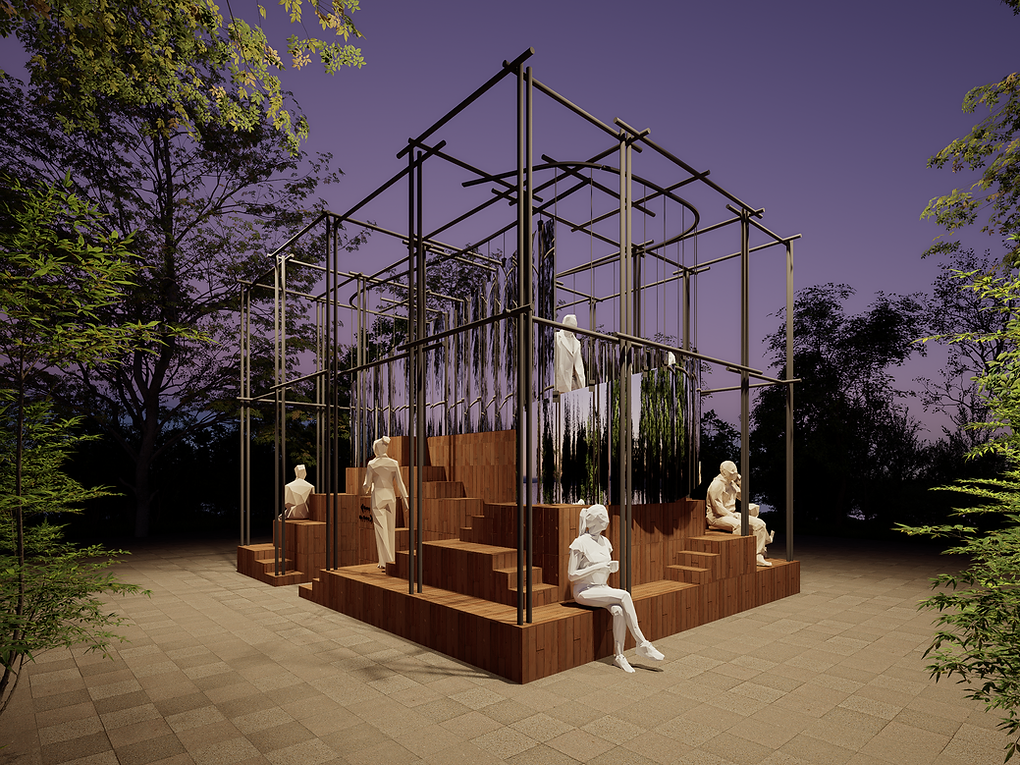
The pavilion reinterprets these streets as spaces that hold activity and pause, density and breathing room, and aspiration and exhaustion all at once. This is expressed through steps and seats—elements that invite gathering, movement, waiting, resting, and encounter. These “streets” descend into the “underbelly” of the pavilion, representing the 67% of Mumbai that lives informally, often without adequate light, ventilation, legality, or dignity, while also acknowledging the informal trades and labour that sustain the city yet remain marginalised. Through projections and layered sound, this space becomes enlivened by real encounters with this unseen infrastructure.
Moving out of the enclosed space and upward one reached the “ivory tower,” constructed from mirror finished acrylic panels. Reaching it is possible, but not fully accessible; the route is uneven and winding, symbolic of the city’s unequal yet persistent promise of upward mobility.
Moving out of the enclosed space and upward one reached the “ivory tower,” constructed from mirror finished acrylic panels. Reaching it is possible, but not fully accessible; the route is uneven and winding, symbolic of the city’s unequal yet persistent promise of upward mobility.
Inside this reflective tower, one encounters distorted versions of oneself and fragments of rare blue sky above. The mirrors bend reality just enough to remind us that such inequality also warps perspective—shaping how we see ourselves, others, and the city.
The entire pavilion sits within a scaffolding frame, referencing the city’s constant state of construction. Old, used saree fabric offers shade, softness, memory, and the presence of craft, reminding us that amidst machinery, ambition, and strain, it is people and resilience that continue to give Mumbai its spirit.
Materials + Modularity
The pavilion is constructed as a modular system, allowing it to be assembled, adapted, dismantled, and reused. A uniform MS scaffolding frame forms the structure supporting the Ivory tower panels and will return to construction use after the festival. Within this framework, the steps and seating are created from modular wooden boxes made from recycled packing crates, internally supported by mild steel frames and treated for durability. Designed beyond the festival, these modules can be detached and relocated across the city, continuing to serve as places of rest and everyday urban pause.
The Ivory Tower uses waste commercial plywood as the core material, clad with mirror finished acrylic panels supported by the scaffolding above and wooden modules below. After dismantling, these panels will be reused as architectural elements elsewhere. Together, these strategies prioritise reuse, circularity, and continued relevance, allowing the pavilion to live on through its parts well beyond the event.

What the streets remember
Despite everything - the grit, hustle, exhaustion, and inequity - our memories of the city are not only of hardship. They are of kindness, humour, and familiarity. Of a vada pav vendor slipping in an extra pav after a tiring day, of strangers steadying you when you trip on an uneven pavement, of unexpected generosity in the most crowded moments. Our pavilion attempts to hold all of that: the aspiration and the discomfort, the harshness and the humanity, the city as it is and the city as it hopes to be.
A reflection on a city where hardship and hope coexist, and where everyday acts of kindness and shared humanity soften the grit of urban life.


