

Archeological Museum, Hampi
Culture Architecture I Hampi, Karnataka
Area 25,250 sq ft
Status Ongoing
Client JSW Foundation & ASI
Team Shimul Javeri Kadri, Sarika Shetty, Heer Shah, Tanvi Oswal
Past Contributors Meet Mendpara, Nessia Chitre, Tharun CM, Sejal Selwadiya, Dhanvi Shah, Nandan Vaishnav, Rushikesh Shetye, Shivansh Agrawal, Abhishek Hippargekar
Graphics OASES Design
Museum Planners BRMA
Landscape VSLA
Structures GMR Consultants
MEPF ESVE Design
The museum becomes the definitive interpretation centre for understanding the holistic story of Hampi and the Vijayanagara empire.
The ASI Museum revitalisation transforms a static 1972 institution into a dynamic gateway to Hampi’s heritage landscape. The Archaeological Museum Hampi houses an extensive collection of sculptures, inscriptions, architectural fragments, and everyday objects that frame Hampi within a broader historical continuum.
Comprehensively reimagined in 2026 through strategic adaptive reuse, the design retains the original structural framework while intervening inside and out to improve accessibility, climate responsiveness, and curatorial scope. By integrating architectural interventions, shaded landscapes, and immersive spatial narratives, the renewed museum acts as a vital cultural anchor that honours Hampi’s living heritage for visitors of all ages.
Creating a Sense of Arrival
Integrating existing copper pod trees at the entrance plaza creates a place of shade, rest, and respite from Hampi's intense heat. Inspired by the proportions of Hampi’s historic bazaars, the entrance colonnade creates a distinctive landmark for Kamalapura.
A clear hierarchy of spaces ensures a smooth and intuitive transition from the waiting area, ticketing, and baggage drop to the security zone, offering visitors a seamless and secure arrival experience.
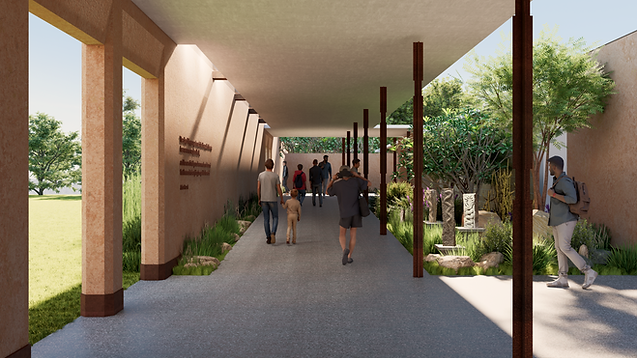

A series of shaded pavilions and landscaped groves introduced within the masterplan are designed for universal access and to create moments of pause.

Shaded Pavillions
A series of shaded pavilions and landscaped groves introduced within the masterplan are designed for universal access and to create moments of pause.
These linear pavilions are defined by solid walls on one side and a colonnade of finely crafted MS columns on the other, balancing enclosure and openness.
The contextual display of artefacts, brought to life through local crafts, materials, and murals, creates a strong sense of place and association—rooting the experience in the very landscape and traditions that shaped the Vijayanagara Empire.
A Mythological Landscape
The visitor journey extends beyond enclosed galleries into an immersive landscape of vanas and aranyas, thoughtfully curated around existing sculptures scattered across the grounds.
Through spatial and graphic interventions, these fixed artefacts are woven into a playful mythological thread that complements the museum’s historical narrative.
Designed for visitors of all ages, this living garden evolves with seasonal fruiting and flowering - inviting sensory, informal learning rooted in wonder.


